
Prices of agricultural commodities have risen 23 per cent so far this month.
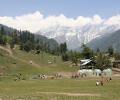
Even as swine flu is threatening the hospitality industry, travellers are taking advantage of the Independence Day holiday to pack their bags for a weekend trip. Most hotels at travel destinations, domestic and international, are packed for the weekend.

This upturn comes soon after an earlier stalling of demand. In February, DLF, the country's largest property developer, said it had stalled construction on 16 million sq ft of commercial space (retail and office) due to lack of demand. So, too, with other developers like Unitech, Parsvnath and Raheja, who either stalled or slowed the construction of their commercial properties because of a demand-supply mismatch.

Property developers plan more launches in the sub-Rs 20 lakh category of homes, after Monday's Budget concession.

The government-owned hospitality chain, which lost almost all of its duty-free shops (barring two) to others as a result of the competitive bidding in the last couple of years, intends to regain its market share - at least marginally- in the next one year.
After commercial districts, residential markets and malls, fast-food chains like McDonald's, Barista Coffee and Nirula's have now trained their guns on highways. With the improved road network, brand-conscious Indians have begun to travel like never before.
They have graduated from just home delivery to SMS marketing, bulk buying alliances and credit extensions.
With the monsoon season to begin and hotels hoping for a robust business at leisure destinations, swine flu could play spoilsport for the hotels, said industry players. At leisure destinations, international tourists form around 35 per cent of the clientele, with around 20-25 per cent coming from the US alone. Last year, tourist arrival in the country was 5.37 million, a fifth of whom stayed in five star hotels.
Whether it would help these cash-starved firms to improve their profit margins is yet to be seen, but such a move would send a strong signal that the phase of price correction is over. "Developers want to send signals that they are good. But if they are increasing above 10-15 per cent, it would be irrational," said Sanjay Dutt, chief executive of Jones Lang LaSalle Meghraj, a property consultant.
Real estate companies are now going to the other extreme and falling over each other to offer affordable housing at a price range of Rs 500,000 to Rs 50 lakhs (Rs 5 million). The varied pricing is a function of affordability being a relative term, depending on the location. For instance, a Rs 50- lakh (Rs 5-million) apartment in Mumbai is considered affordable housing. In a city like Nagpur, the same price will qualify for premium housing.
While the sudden rise in demand for affordable residential housing in the last couple of months has given the much-needed relief to real estate developers, commercial and retail segments continue to face the heat of oversupply, combined with declining rental rates and lower demand from investors.
Speculators often leveraged volume discounts on property purchases to re-sell them at prices lower than those available to individual buyers. This created problems for realtors when demand slowed, since it put pressure on them to take a hit on margins and lower prices still further. The lock-ins are expected to be introduced mostly for mid-income projects that offer prices 20 to 30 per cent below the market and, therefore, attract more undercutting from bulk discount buyers.
Developers who are launching new projects are opting for this route, as they need not pay the entire amount in one lot and owners need not forego the potential rise in value. As much as 70 per cent of land deals in the country take place through this model now, against 40-45 per cent a couple of years earlier, say property consultants.
Even as the outbound tourism sector is feeling slowdown jitters, cruise tourism is becoming popular with Indians. Bookings for April went by 20 per cent.
Most developers charge 18 per cent annual penalty from defaulting customers. Over the past year, many people who had booked a home on installments have lost jobs or taken salary cuts. The past 6-9 months have seen many of them defaulting on payments. "The move to waive penalty on late payment is a smart move. This will provide customers the much-needed cushion at a time when a lot of them may want to back out due to their financial condition," said a real-estate consultant.
After a dismal 2008, the travel and hospitality industry is set to receive yet another setback, this time due to the outbreak of swine flu, which may curb inbound and outbound tourist movement. The flu spreads among humans through contact with infected pigs.
DLF, the country's largest property developer, might offer another three rent-free months to retailers at its malls in South Delhi, who have begun an agitation against the company.
"The customers had entered into a three-year contract with us. If we have to sell the apartments at a discounted rate, the customers who are backing out should make up for it," an official said. "If DFL tries to re-sell its apartments in the open market, it will have to reduce prices by a further 10-15 per cent. The new buyers know the expected supply is more than demand," said Rupesh Sankhe, equity analyst, Centrum Broking.
DLF, the country's largest property developer, may retrade its apartments at New Town Heights, Gurgaon, and Garden City, Chennai, at a discount. This is to refund buyers who want to exit the projects, according to a senior company official.
Indian Hotels, which owns the luxury Taj brand of hotels, may see its profit decline 47 per cent to Rs 200 crore (Rs 2 billion) from Rs 377 crore (Rs 3.77 billion) last year for the fiscal ending March. EIH, a part of the Oberoi Group, is likely to see a profit figure of Rs 154 crore (Rs 1.54 billion) from Rs 223.6 crore (Rs 2.23 billion) , a fall of 31 per cent, a survey of analysts has said.
